killing characters
Jan. 21st, 2014 07:29 pm![[personal profile]](https://www.dreamwidth.org/img/silk/identity/user.png) marycatelli
marycatelliWhat does it take to kill off a character well?
Many speculative stories kill off characters by the thousands, and it means nothing to the reader. You have to buy the reader's interest in the character -- and then kill him.
(I think one of the best comments on that is this:
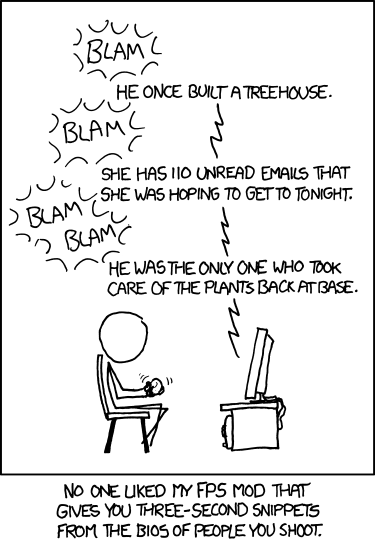 )
)
But if the reader's to be effected you have to get their emotions.
Complaints about the girlfriend or mother who's killed just to give the main character some grief and a motive for revenge. (Though I find these -- overblown. Everything in a story is about the main character and is done to affect him.)
The many times they've been writing along and realizing this guy has to die. Or that having foreshadowing his having been killed by this character, he dies at that character's hands.
Many speculative stories kill off characters by the thousands, and it means nothing to the reader. You have to buy the reader's interest in the character -- and then kill him.
(I think one of the best comments on that is this:
)But if the reader's to be effected you have to get their emotions.
Complaints about the girlfriend or mother who's killed just to give the main character some grief and a motive for revenge. (Though I find these -- overblown. Everything in a story is about the main character and is done to affect him.)
The many times they've been writing along and realizing this guy has to die. Or that having foreshadowing his having been killed by this character, he dies at that character's hands.
![[identity profile]](https://www.dreamwidth.org/img/silk/identity/openid.png)
no subject
Date: 2014-01-22 08:37 am (UTC)A character death with dramatic meaning should be a sacrifice for the writer as well as the reader, because they are both cashing out on the investment made to build up the character. On the one hand the dramatic payoff had better be worth it. On the other, you can't expect a payoff wildly out of proportion with the investment. You kill off an undeveloped character, you get a lukewarm response.
I think that's the real problem with the Woman in the Fridge trope you were referring to. Fridge Women come in two flavors: The first is a character in her own right who was sacrificed not because it made sense for her story but to give the hero motivation, which is a waste of investment. The second is a plot point with a name and a face who existed solely to die and give the hero motivation, in which case there wasn't enough investment to care about either her or the hero's grief/rage/despair. It's not emotional engagement, just formula: "I lost my X therefore I must do Y."
Sorry for the long comment, character death is just something I've given quite a bit of thought to. In fact I killed one off horribly just yesterday.
no subject
Date: 2014-01-22 01:46 pm (UTC)no subject
Date: 2014-01-22 03:57 pm (UTC)no subject
Date: 2014-01-22 05:11 pm (UTC)no subject
Date: 2014-01-22 06:19 pm (UTC)no subject
Date: 2014-01-23 03:16 am (UTC)no subject
Date: 2014-01-23 03:40 am (UTC)no subject
Date: 2014-01-23 04:28 am (UTC)no subject
Date: 2014-01-23 05:24 am (UTC)It's a particular problem that women are disproportionally fridged this way, since it both reflects and reinforces the view of women as tools and props in men's stories. Fridged women's lives are erased except as how they relate to a man's. See also: Manpain. http://thingswithwings.dreamwidth.org/145564.html
no subject
Date: 2014-01-23 01:34 pm (UTC)The fuss about it is feeding the fire, not quenching it. Because the way it ignores the way MEN are treated as cheap deaths in fiction and makes a tremendous fuss about any woman's death only reinforces the notion that men's deaths are nothing, and women's are important. That is the notion that causes it to happen disproportionately to women, because their deaths count.
no subject
Date: 2014-01-23 01:58 pm (UTC)Outside the protagonist's sphere, yes, plenty of male characters suffer throwaway deaths. So do female characters, frequently with rape in the mix.
And are you seriously saying that talking about the negative aspects of women's media portrayal is a detriment to men? There's an actual quota for human worth and respect in the stories we tell? Yes, there are problems with portrayals with men in media, for instance in the narrative that says men can't cry for themselves or for ordinary suffering. And no, evul feminazis did not create that problem by hating the menz. Yeesh.
no subject
Date: 2014-01-23 11:17 pm (UTC)And of course you can not possibly be serious in that question. I explicitly pointed out that the approach given is actively undermining YOUR OWN AIM. (Cranking it up to the claim that you "created that problem" is your own febrile imagination.)
no subject
Date: 2014-01-24 01:37 am (UTC)Throwaway male deaths could be a problem, but they're a different subject. And I don't think male extras' deaths are the main problem, personally, because these same stories usually have plenty of male characters in dramatically significant roles. Are you going to argue with a straight face that Lord of the Rings, a story where most of the main cast are male, is sexist against MEN because most of its throwaway deaths are suffered by male characters? If anything, the gender compositions of both the main cast and the soldiers reflect a world where men are expected to be in positions of power and action while women stay safely home. This has all sorts of gender implications, of course, and lots of class implications in the contrast between the significant versus insignificant male characters, but the message is not that (all) men's lives are worthless. At best the spear-carriers' are, and that's a subject well worth discussing but a different subject.
I explicitly pointed out that the approach given is actively undermining YOUR OWN AIM.
You actually didn't make that point as explicitly as you thought, given that the paragraph prior to that sentence discussed something completely different and the use of pronouns was confusing, but hey. How am I undermining my own aim? I'm honestly curious.
no subject
Date: 2014-01-24 01:55 am (UTC)Whereas YOU are trying to change the subject. LOTR contain zero revenge-motivating deaths, and so is irrelevant to the question at hand.
no subject
Date: 2014-01-24 02:59 am (UTC)That said I haven't conceded the point at all, just failed to keep my terms straight. In a way you're right that all a woman needs to do is die for her death to have significance (at least purportedly) while a male character whose death is motivation has to do something. To me though that's exactly the problem一these women don't have stories of their own, yet somehow we're supposed to care for them. We don't, actually we can't, since we don't know them and we can only care for the often male hero whose story we do know. The women in these revenge narratives are erased, becoming plot points instead of characters.
And yes, that's the way the story is structured and it makes sense in that story. But why is the story structured that way? Why do we as a culture so disproportionately create stories where women are killed so men's stories can begin? Unless we examine these questions critically we'll keep doing the same things. It doesn't mean these stories automatically suck (though the writing does suffer for the above reasons) or that people who write them are bad, it means there is worth in examining certain assumptions.
With LotR I was answering your point about throwaway male deaths一i.e. the deaths of characters who don't matter to the hero. I had already argued, unrelated to LotR, that characters who matter to the hero can and have been motivations for revenge, countering your claim that male deaths don't matter in fiction. With the LotR example I answered your point about the throwaway deaths of characters who don't have that dramatic status in the story, by countering that the preponderance of male spear-carrier deaths usually reflect the society's gender roles. Does that make things clearer?
no subject
Date: 2014-01-24 03:09 am (UTC)no subject
Date: 2014-01-24 04:30 am (UTC)But to try one last time, first, it's not that men's deaths don't matter. When a male character matters to the protagonist the death of that father, son, friend etc. can be motivation for revenge. If nothing else can you please understand that the worthlessness of men is not the issue here?
Second, the problem I raise is not that women die in these stories but that their lives don't matter. So often in these revenge narratives the only significant thing Fridged women do is die. Doesn't that seem a bit iffy to you, too?
Third, I'm not saying these stories themselves are a problem that should stop, like, right now. That is not my goal. I'm questioning the cultural assumptions they come from, and also criticizing the effectiveness of the storytelling in that regard.
Am I making any sense at all, or am I just talking to myself? I'll stop if I'm annoying you, of course一I assumed you're interested since you replied to my comments, but if this actually bores you and that's why you don't seem to be reading or responding to the actual points I'm making, it's probably more productive to let the subject rest.
no subject
Date: 2014-01-24 11:48 pm (UTC)Patronizing much?
no subject
Date: 2014-01-25 04:17 am (UTC)But what's happening is that we're talking about completely different things. I talk about agency in women's stories, and you keep talking about the worthlessness of men's lives in fiction (which, quite aside from the fact that the hero is often male isn't even true in itself (http://tvtropes.org/pmwiki/pmwiki.php/Main/YouKilledMyFather), but you won't address that). I talk about critiquing culture, and you talk about my wanting these stories to stop--which I said at least twice isn't my goal, though it would be a byproduct of the kind of changes I and other feminists would like to see.
So either you don't care enough about this discussion to read and understand my points, or you're making leaps of logic that I can't understand and you refuse to explain. Either seems a good reason to end things here because seriously, this is one of the most surreal debates I have ever had.
no subject
Date: 2014-01-25 04:38 pm (UTC)No, you claimed that women's lives are worth less than men's. Like this, "their lives don't matter." You dragged in your claims about agency as supporting evidence in that case. I pointed that in fact men's lives are deemed important than women's, and you admitted that this was so. Like this, "all a woman needs to do is die for her death to have significance (at least purportedly) while a male character whose death is motivation has to do something" And yet you went on claiming that when the loss of one life treated as more significant than another, nevertheless the first life doesn't matter, and the second one does.
To claim it was all about agency is pure and simple arrogance on your part. Hint: look at the title of post. It's "killing characters."